Quality Control: DVARS and FD-DVARS correlations
The tmfc_calculate_DVARS function calculates DVARS within the GM mask before and after noise regression.
It is called automatically by the main function TMFC_denoise if the user has selected the corresponding option, or it can be run manually:
[preDVARS,postDVARS] = tmfc_calculate_DVARS(FD,SPM_paths,options,masks,output_paths);
The outputs are saved in TMFC_denoise/[WM*e*]_[CSF*e*]_[GM*d*] subfolders:
DVARS_before_denoising.mat– contains DVARS time series for each session before noise regression, session-wise FD-DVARS and task-DVARS correlations, and mean/max FD-DVARS (and task-DVARS) correlation across sessions.
DVARS_*.mat– contains the same information as the previous file, but after noise regression. Filenames encode the selected denoising options (e.g.,DVARS_[24HMP]_[aCompCor50]_[rWLS].mat).
The GUI window for DVARS time-series inspection, report generation, and QC plot visualization is opened with tmfc_plot_DVARS. It is called automatically by the main function TMFC_denoise.
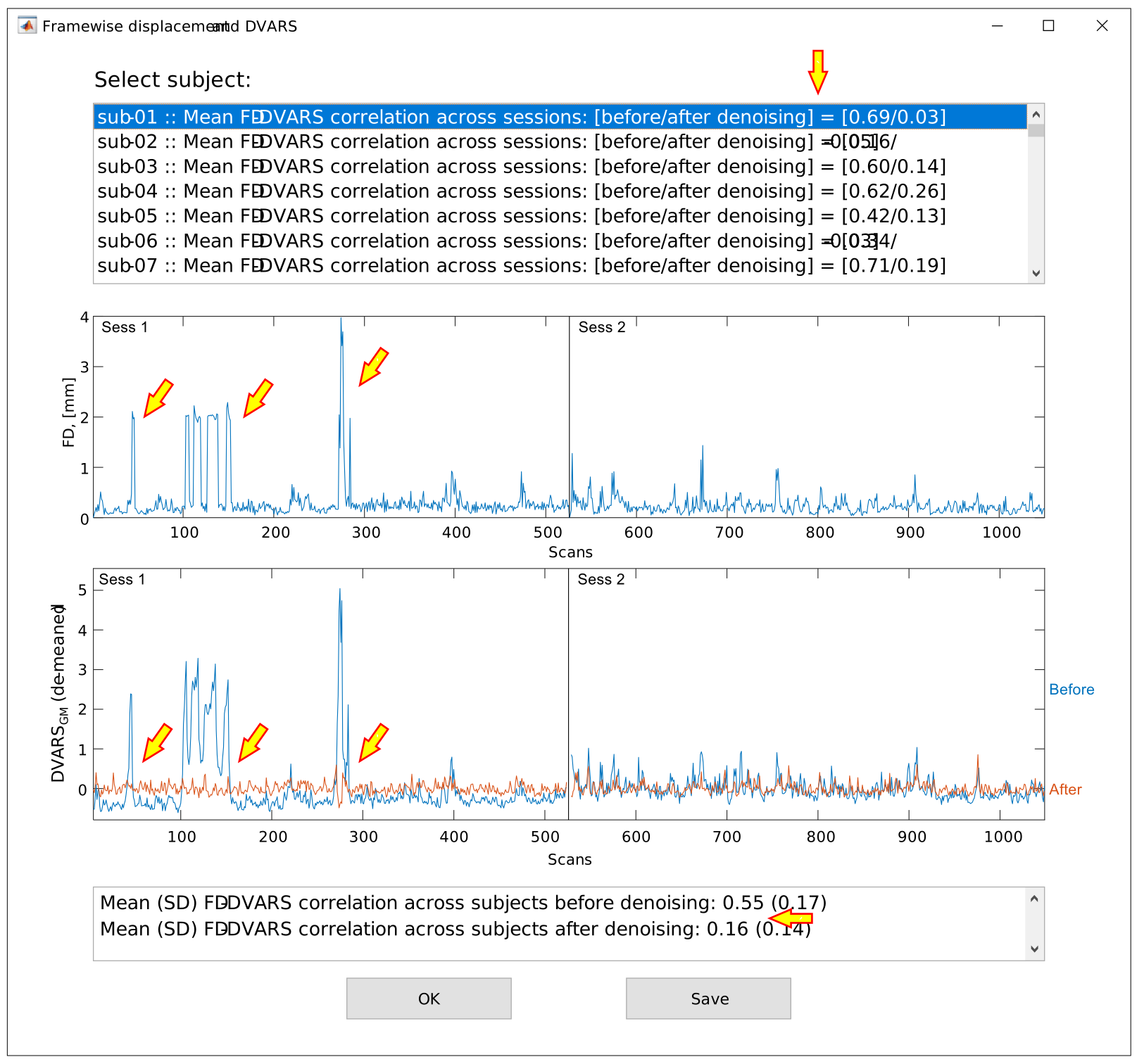
Graphical interface for DVARS time-series inspection. Example DVARS plot for a single subject. The FD-DVARS correlation was reduced from 0.69 to 0.03 after noise regression. Spikes in the DVARS time series during the first session, associated with high-motion events, were visibly diminished. At the group level, the mean FD-DVARS correlation was decreased toward zero.
To open DVARS plot GUI manually run:
% Allows saving group FD-DVARS statistics only:
tmfc_plot_DVARS(preDVARS,postDVARS,FD);

% Allows saving group FD-DVARS statistics and TMFC denoise settings:
tmfc_plot_DVARS(preDVARS,postDVARS,FD,options,SPM_paths,subject_paths,anat_paths,func_paths,masks);
Pressing the button stores individual subject FD and DVARS data, as well as group-wise DVARS statistics, in a single *.mat file:
Field |
Description |
|---|---|
denoising_settings (struct) |
Selected TMFC_denoise settings:
|
FD (struct) |
Individual FD data for all subjects (see HMP expansions and FD plots). |
group_mean_post_FD_DVARS_corr |
Group mean FD-DVARS correlation after denoising. |
group_mean_pre_FD_DVARS_corr |
Group mean FD-DVARS correlation before denoising. |
group_SD_post_FD_DVARS_corr |
Group SD of FD-DVARS correlation after denoising. |
group_SD_pre_FD_DVARS_corr |
Group SD of FD-DVARS correlation before denoising. |
postDVARS (struct) |
DVARS data for each subject (after denoising).
|
preDVARS (struct) |
DVARS data for each subject (before denoising).
|
These values can be reported to demonstrate the effectiveness of noise regression. If denoising is successful, spikes in the DVARS time series at high-motion time points should be reduced, and the FD-DVARS correlation should approach zero.
Pressing the button opens a text report that summarizes the selected denoising strategy, mask parameters, motion statistics, FD-DVARS correlations, task-FD and task-DVARS correlations, and the number of nuisance regressors. The report can be copied from the GUI or saved as a *.txt file.
Pressing the plots button opens additional QC figures, including subject-level FD-DVARS plots, group-level FD-DVARS summaries, motion summaries, and task-correlation summaries. These figures can be saved manually from the MATLAB figure window.