Overview
TMFC_denoise provides both a graphical user interface (GUI) and command-line functionality.
To open the GUI, run the TMFC_denoise.m function in MATLAB.
TMFC_denoise generates nuisance regressors, calculates quality control (QC) measures, and estimates updated GLMs using weighted least-squares (WLS) or robust WLS (rWLS).
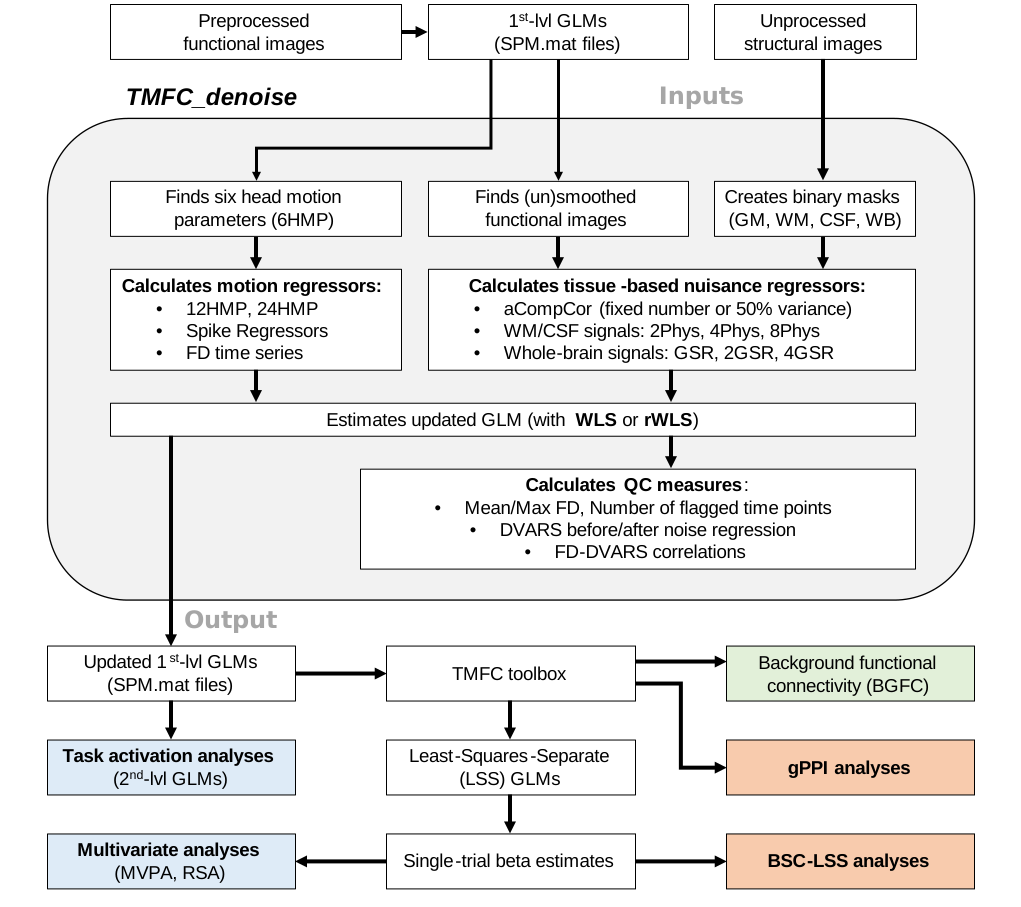
TMFC_denoise overview.
Inputs
Inputs include structural images in native space and preprocessed functional images, together with first-level GLMs specified in SPM.
Users specify paths to first-level GLMs (SPM.mat files), select denoising options,
and set masking parameters. First-level GLMs must be specified and estimated in SPM12 or SPM25 and
must include six head motion regressors.
Structural images in native space and preprocessed functional images can be automatically identified through the GUI.
Functional images may be preprocessed using an SPM-based pipeline
(e.g., see the preproc_fmri.m function in /spm/batches/; Penny et al., 2011)
or with alternative pipelines such as fMRIPrep (Esteban et al., 2019).
Preprocessing should include realignment and normalization, whereas slice-time correction and smoothing are optional.
Denoising Options
Head motion expansions
Framewise displacement (FD) and task-FD correlations
Spike regressors
aCompCor regressors
WM/CSF regressors
Global signal regressors (GSR)
DVARS (Derivative of root mean square VARiance over voxelS), FD-DVARS correlations, and task-DVARS correlations
Robust weighted least squares (rWLS)
Outputs
All outputs, including noise regressors, updated GLMs, and QC measures,
are saved in a TMFC_denoise subfolder within each subject’s first-level GLM directory.
Group-level QC measures can be saved as a single .mat file in a user-specified directory.
The report can also be saved as a .txt file and used to facilitate reporting of denoising procedures.
How to Use Updated GLMs
Updated GLMs can be used for task-based activation analyses.
Updated GLMs can be used as input to the TMFC toolbox, which implements:
Background functional connectivity (BGFC)
Least-squares-separate (LSS) GLMs
Beta-series correlation (BSC-LSS) and beta scrubbing
gPPI with deconvolution
3. The TMFC toolbox can also generate denoised volume of interest (VOI) files
for dynamic causal modelling (DCM). Note: The original model should be prepared for DCM analysis.
Both TMFC_denoise and the TMFC toolbox support SPM.mat files with concatenated sessions (i.e. spm_fmri_concatenate.m).
4. Denoised single-trial beta estimates (outputs of LSS GLMs) can also be used for multivariate approaches, including multivoxel pattern analysis (MVPA) and representational similarity analysis (RSA).